Suppose you are 36, but WHOOP shows 41. Your first thought may not be about keeping a regular bedtime, but whether your body has really aged that much.
Do not rush to adopt that number as your new age. WHOOP Age is an age score calculated by a model from behavior and selected body data. It is not a cellular-age test, and it does not say how many years you have left.[1][2]
The number to read alongside it is Pace of Aging, because an app age that remains high can still come with a recent trend that is improving. All ages in this article are fictional examples for explanation, not customer results or results from testing by the store.[1][2]
Two numbers, two different questions
Healthspan is the feature name that combines WHOOP Age and Pace of Aging. In general use, healthspan means the period of life spent in good health without chronic disease or disability—not the total number of years lived.[2]
WHOOP Age presents long-term data as an age. Pace of Aging shows which way WHOOP Age is likely to move if the recent pattern continues. Read both rather than focusing only on how many years the app age sits below your chronological age.[1][3]
The data windows differ, so the values do not have to move together.[1][3]
| What it shows | WHOOP Age | Pace of Aging |
|---|---|---|
| Value format | Age, such as 41 years | Rate, such as 0.8x |
| Main data window | 6-month rolling average | Emphasizes the latest 30 days |
| What it is used for | The model’s long-term picture | Direction projected by the model from recent data |
| How quickly change appears | Moves gradually | Responds to new data more quickly |
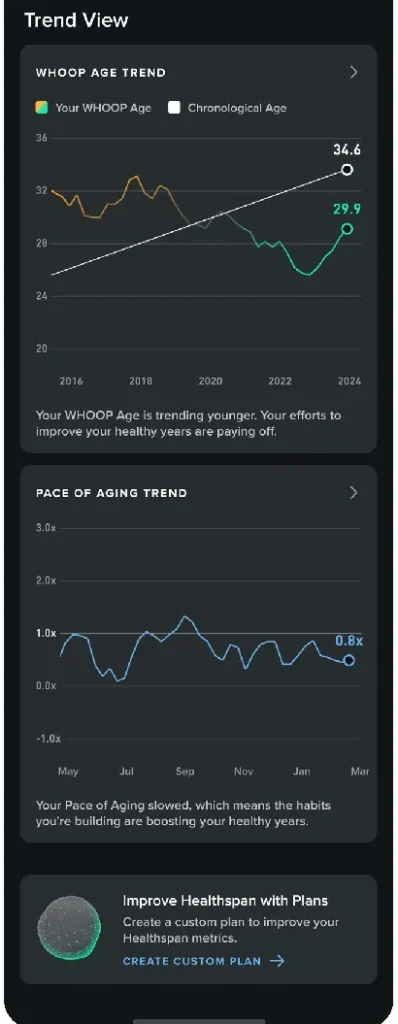
Both values update weekly; they are not scores to chase every morning. Here, age is also the model’s way of condensing data into an easy-to-read form—not the age of every organ in the body.[1][2][3]
WHOOP Age is not a cellular-age test
WHOOP translates research on associations among behavior, health metrics, and all-cause mortality risk into effects measured in years, then combines them with chronological age using the company’s methodology. It is therefore better understood as a model-derived equivalent age than as a second, hidden biological age detected in the body.[2][3]
The inputs do not come from DNA testing or methylation patterns, so this is not the same as an epigenetic clock test. The two results should not be treated as interchangeable without direct comparative validation.[2]
WHOOP’s reference point is not the average person of the same age. It uses health benchmarks selected by the company from guidance and research. If WHOOP Age equals chronological age, that means the overall result aligns with the model’s benchmarks—not that every aspect of health has tested normal.[2][3]
A WHOOP Age below your chronological age does not mean you are disease-free, and a higher value is not a diagnosis of premature aging.[2][3]
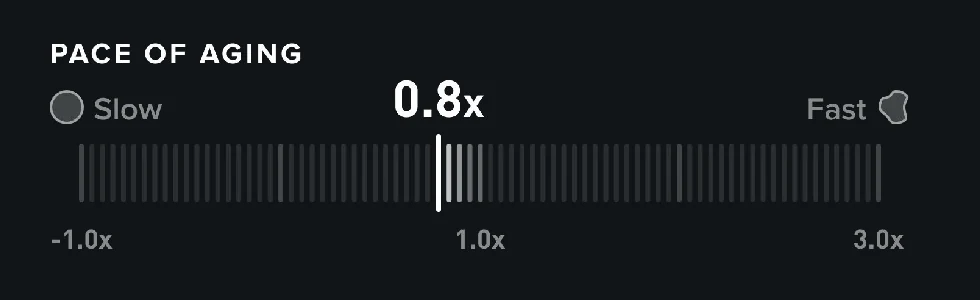
0.8x does not mean aging in reverse
Pace of Aging uses the latest 30 days of data to project how WHOOP Age would change relative to the passage of time if the pattern continued. A value below 1 is therefore not the same as a negative value.[2][3]
- 1.2x
- WHOOP Age is projected to increase faster than calendar time
- 1.0x
- WHOOP Age is projected to increase at the same rate as time
- 0.8x
- WHOOP Age is still projected to increase, but more slowly than time
- 0.0x
- WHOOP Age is projected to remain unchanged even as chronological age increases
- Negative value
- WHOOP Age is projected by the model to decrease
The key point is that WHOOP Age is not a directly measured cellular age. A value of 0.8x is therefore not evidence that biological aging has slowed by 20%, and it cannot be used to calculate how many additional years someone will live.[2][3]
Suppose your chronological age is 36, WHOOP Age is 41, and Pace is 0.8x. The long-term picture remains above your chronological age, while recent data points toward WHOOP Age increasing more slowly than time. The two values do not conflict.
Conversely, if your chronological age is 36, WHOOP Age is 31, and Pace is 1.2x, that does not mean the app is broken. The existing long-term picture remains below your chronological age, but if the recent pattern continues, the model projects that WHOOP Age will increase faster than time. These two fictional examples teach how to read the values; they are not formulas for predicting individual outcomes.
The score uses 9 inputs—not sensors that measure everything
Healthspan uses 9 inputs across sleep, activity, and fitness. Time in heart-rate zones counts as two inputs—zones 1–3 and zones 4–5—but not all inputs are measured directly at the wrist in the same way.[1][3]
Sleep: duration and consistency
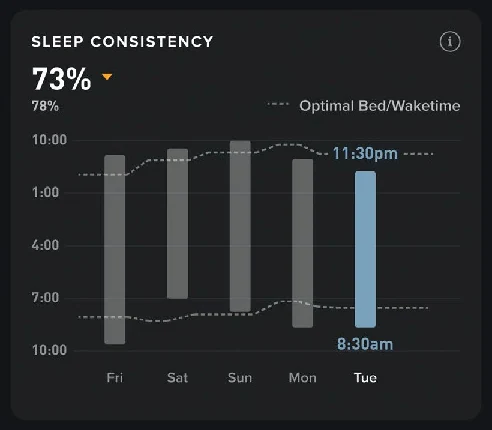
The first two inputs are sleep duration and Sleep Consistency, meaning the regularity of sleep and wake times. Consider a week when you sleep enough but go to bed at a different time each night: quantity and consistency tell different parts of the story.[3]
The chart below is an example from WHOOP, not a schedule everyone must follow. Sleep data from wearables also remains an estimate, not a laboratory sleep-test result.[4]
Activity: heart-rate zones, strength training, and steps
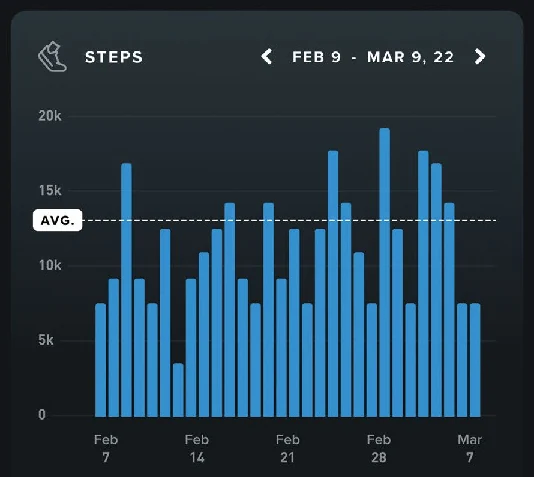
The next four inputs are time in heart-rate zones 1–3, time in zones 4–5, qualifying strength activity, and step count. Each value therefore depends on both the data the device collects and the activities recorded.[1][3]
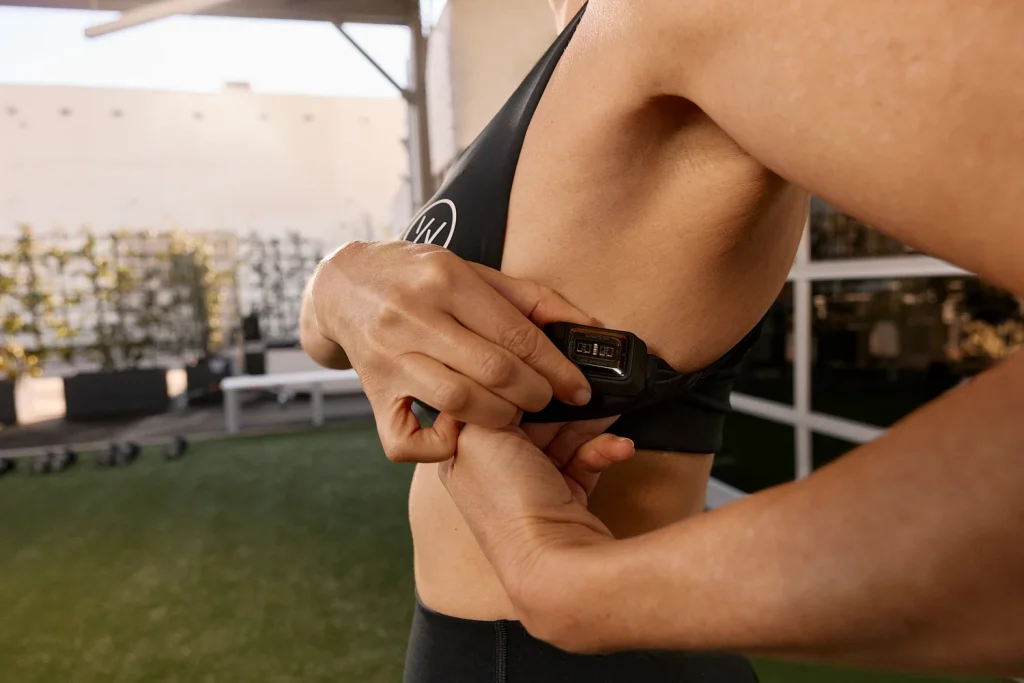
Including strength-training time in the score does not mean WHOOP can measure muscle size. Step count is also estimated from movement. For Healthspan, WHOOP’s current guidance recommends wearing the device on the wrist throughout the day for suitable step-count collection; do not assume every wear location gives the same result.[1][2]

Fitness: resting heart rate, VO₂ Max, and lean body mass
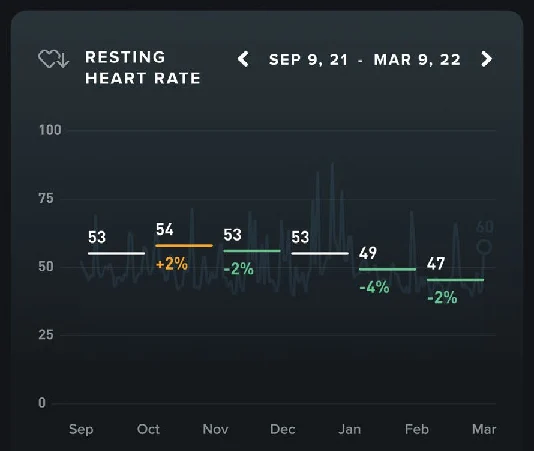
The final three inputs are resting heart rate (RHR), estimated VO₂ Max, and lean body mass percentage. Check where each value comes from before concluding that WHOOP measures every aspect of the body.[1][2]
WHOOP’s VO₂ Max is a model estimate, not a direct measurement of oxygen use from a laboratory mask test. If you have a laboratory result, WHOOP allows you to enter it as a reference point.[5]
The WHOOP device does not measure lean body mass directly. The system must receive the information from another source or from user input, and lean body mass is not the same as muscle mass. If this input is unavailable, WHOOP documentation says it is excluded from the score calculation.[2]
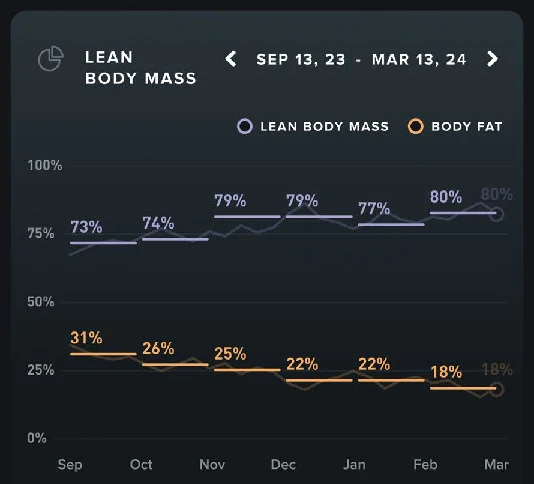
Before assuming your body changed quickly, check whether entered data, heart-rate zone settings, or VO₂ Max were edited. A change in input data can change the calculation, but it does not mean your body changed to the same degree that day.[1][3]
Who can use it, and how much data is required?
As checked on October 19, 2026, Healthspan is included in Peak and Life memberships for people aged 18 and over, and the Thailand sign-up page lists the feature. One does not include Healthspan. Membership eligibility must be considered separately from the device model name.[1][3][6]
Current guidance lists WHOOP 4.0, 5.0, and MG as supported with an eligible membership. But Healthspan support does not mean the store’s bands work across models. LUXE MORE bands support WHOOP 5.0 and MG, not 4.0.[1][9]
To start, WHOOP requires at least 21 Recoveries within the first 31 days. After that, at least 21 Recoveries are required in each rolling 31-day window to continue receiving updates. Simply reaching 21 calendar days does not confirm that the data requirement has been met.[1][3]
The guidance says the system becomes fully calibrated after 90 days, while WHOOP Age uses a 6-month rolling average. These are different time frames. The documentation does not explain in detail how the calculation works before a full 6 months of data is available. During setup, check the data status in the app rather than assuming the score will stabilize as soon as a set number of days has passed.[1][2]
How strong is the research support?
Citing research does not mean the combined score has been validated in every respect. WHOOP provides documentation describing its model, and published studies have tested certain types of device data, but those are two distinct bodies of evidence.[2][4][7]
For example, a 2025 study in Physiological Reports compared nighttime resting heart rate and HRV from WHOOP 4.0 with ECG signals in 13 healthy adults. It helps assess sensor-level data within the study’s scope; it did not test WHOOP Age or show that the score predicts lifespan.[7]
A search for the feature names in PubMed titles and abstracts, together with a Europe PMC search, found no published study directly validating WHOOP Age and Pace of Aging as of October 19, 2026. This search did not cover every possible title or database and does not establish that no research is under way. The score should therefore not be used to predict an individual’s mortality.[2][10][11]
WHOOP’s own documentation also notes limitations. Much of the research used to build the model is observational, so associations are not evidence of cause and effect for an individual. The model also does not cover every aspect of health, including diet, social relationships, and mental well-being.[2]
Advanced Labs blood-test results shown within Healthspan do not directly change WHOOP Age or Pace of Aging under the current guidance. More information appearing in the app does not mean it has been added to the scoring formula.[1][3]
An app age falling by 5 years does not mean you will live 5 years longer. A favorable score cannot replace health screening or medical evaluation of symptoms.[2]
What to do after opening Healthspan
Start with the inputs moving the score, not with a goal of cutting several years from your age. Review each input’s Age Impact alongside the 30-day data and the long-term picture, then choose something you can realistically change now.[1]
If your sleep timing varies widely, start with a schedule you can sustain. If strength activity was not recorded, check how to log it before deciding the app failed to recognize your exercise. These are ways to interpret the data, not treatment plans or individualized exercise prescriptions.
Return to the data after several more weeks. Do not intensify training just to chase a negative value, and do not push through illness, injury, or recovery solely to improve the score. If you have unusual symptoms, consult a healthcare professional; do not use WHOOP Age to decide whether to seek medical care.
If the age number creates more anxiety than useful change, WHOOP lets you hide Healthspan through its metric-visibility settings. The score should be supporting information, not a verdict you carry all day.[8]
Choose a band for fit—not for an age score
Choose a band for fit and everyday use. Check the device model before ordering and follow the product-care guidance. Do not choose one because you expect a new band to lower WHOOP Age.
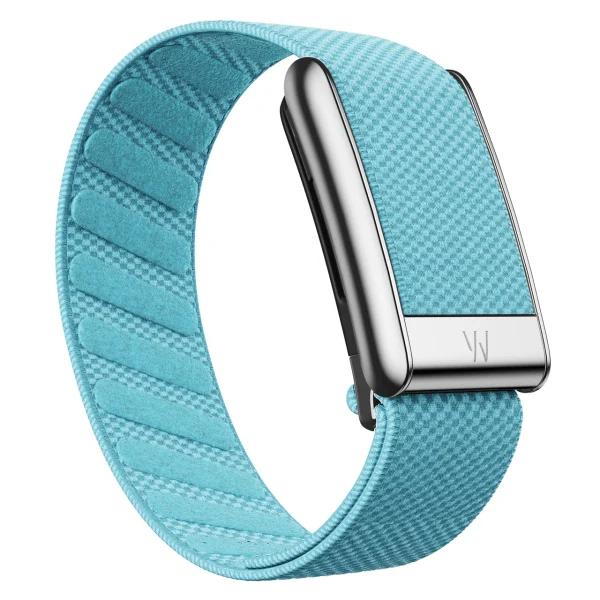
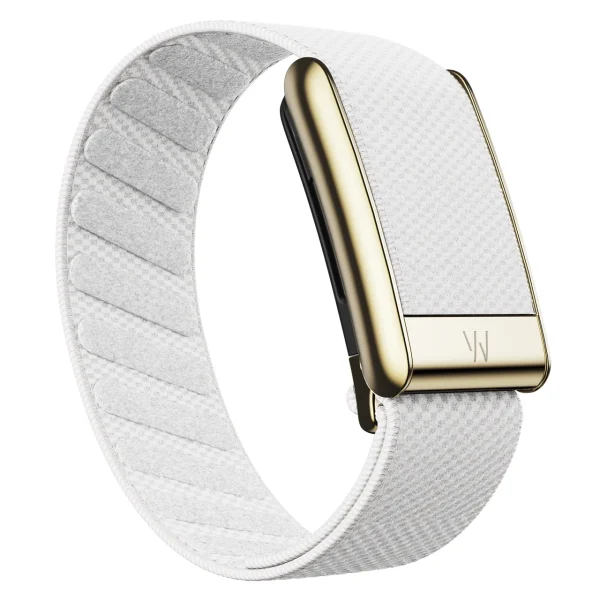
The images below are LUXE MORE product photos showing the actual colors and clasps, separate from WHOOP feature images. The bands and charms are third-party accessories and do not add Healthspan calculation capabilities.[9]


LUXE MORE is an independent third-party retailer and is not affiliated with, endorsed by, sponsored by, or an authorized reseller of WHOOP. WHOOP is a trademark of its respective owner.
Instead of asking how many years younger you are today, choose one thing to track consistently over the next month and use the data to watch how it changes.
Common questions
Does a WHOOP Age above my chronological age mean premature aging?
That conclusion cannot be made from the score. It is a WHOOP model output based on the data used in the calculation. Check the underlying data and the inputs affecting the score, and do not use it as a substitute for diagnosis or a complete health assessment.[1][2]
Does a Pace of Aging below 1 mean WHOOP Age is already decreasing?
Not necessarily. A value between 0 and 1 means WHOOP Age is projected to increase more slowly than time. A value of 0 means it is projected to remain unchanged, while a negative value means the model projects a decrease.[2]
Why has my WHOOP Age not fallen after I improved my habits?
WHOOP Age reflects a long-term average and updates weekly, while Pace of Aging emphasizes the latest 30 days. The two can therefore move in different directions. Also check whether you have enough qualifying data and which inputs affect the score. There is no set number of days within which everyone’s score must fall.[1][2]
Does WHOOP measure muscle mass itself?
WHOOP does not measure muscle mass itself. Healthspan uses lean body mass percentage entered by the user or received from another source. Lean body mass is not muscle mass alone, and WHOOP’s sensor does not directly measure body composition.[2]
Can buying a new band lower WHOOP Age?
There is no evidence that the store’s accessory bands directly lower WHOOP Age. Choose by supported model, fit, color, and use—not by a promise to improve a health score.[9]
Read next
- Your first 7 days with WHOOP
- Understand Recovery, Strain and HRV
- How to wear WHOOP with the right fit and position
- Compare One, Peak, and Life memberships
Sources and images
Information checked on October 19, 2026
- WHOOP Support: Healthspan — WHOOP Age & Pace of Aging GuideEligibility, data windows, calibration, metrics, and limitations. Content was checked against search-indexed text because opening the page directly remained stuck on a loading screen.
- WHOOP: The WHOOP Healthspan Feature — white paperCalculation methods, inputs, and limitations. This is manufacturer documentation, not a journal article independently validating the combined score.
- WHOOP: Healthspan on WHOOP — the nine metrics behind WHOOP Age and the targets for eachA manufacturer article dated January 22, 2026, explaining the metrics, targets, and interpretation of Healthspan, separate from the 2025 launch article. Content was checked against search-indexed text because the site restricts access from some client types.
- Miller et al. (2022): A Validation of Six Wearable Devices for Estimating Sleep, Heart Rate and Heart Rate Variability in Healthy AdultsTested sleep and cardiac data in healthy adults using WHOOP 3.0; did not validate WHOOP Age.
- WHOOP: How accurate is WHOOP VO₂ Max?Explains the VO₂ Max estimate and the use of a laboratory test result as a reference point. Content was checked through search-indexed text.
- WHOOP Thailand: Membership optionsUsed to confirm whether the Thailand membership offer includes Healthspan, not to establish that every other medical feature is fully available.
- Dial et al. (2025): Validation of nocturnal resting heart rate and heart rate variability in consumer wearablesTested WHOOP 4.0 in 13 healthy adults; did not test WHOOP Age or Pace of Aging scores.
- WHOOP Support: Navigating the WHOOP Mobile and Web AppHiding the Healthspan metric in the app. Checked against search-indexed help text.
- LUXE MORE: Buying a WHOOP Band Online—Check the Model and the Store’s Product ScopeSupports information on third-party products and compatible models. Store images were checked against the current gallery and image-source records.
- PubMed: Search for WHOOP Age and WHOOP Pace of AgingUsed an exact-phrase search in titles and abstracts. No results were found when checked on October 19, 2026. This is a feature-name search, not evidence that no research of any kind exists.
- Europe PMC: Search for WHOOP Age and WHOOP Pace of AgingThe saved query returned no results when checked on October 19, 2026. The database response is retained with the review records; no claim is made that every database was searched.