In short
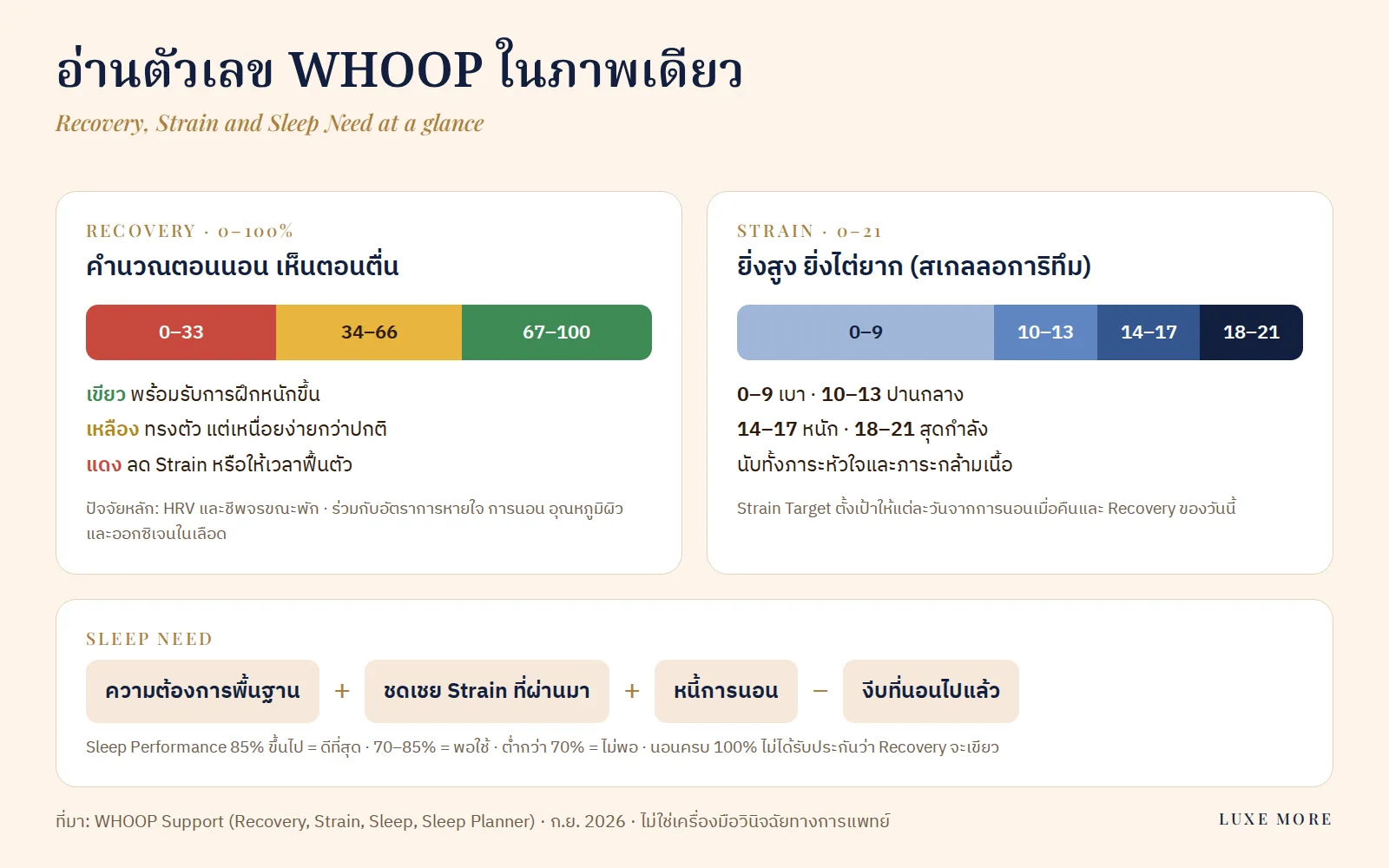
- Recovery runs from 0 to 100%: green is 67% and up, yellow 34–66%, red 33% or below. It is worked out while you sleep and shown when you wake.
- HRV and resting heart rate count most in Recovery, and HRV is compared with your own 30-day baseline, not other people’s.
- Strain is a logarithmic 0–21 scale where every point is harder to earn the higher you go, counting both cardiovascular and muscular load.
- Watch the trend over several days rather than one morning, and remember WHOOP isn’t a medical diagnostic tool.
Open the WHOOP app in the morning and the first thing you see is the Recovery ring, green, yellow or red, followed by a string of numbers that come with little explanation. Here is what each one is built from and how to use it well, based mainly on WHOOP’s own help pages, with research for the general science.
Recovery: what makes it green, yellow or red
Recovery is a 0–100% score for how ready your body is to take on load that day. WHOOP splits it into three colours, with this advice:
| Colour | Range | What WHOOP says |
|---|---|---|
| Green | 67–100% | You can take on a heavier training load. |
| Yellow | 34–66% | Your body is holding steady but tires more easily. |
| Red | 0–33% | Lower your Strain or focus on recovering. |
The inputs are HRV, resting heart rate, breathing rate, hours slept against your need, light sleep and time awake in the night, skin temperature, blood oxygen, and your menstrual phase if you log it; HRV and resting heart rate count the most. Recovery is calculated while you sleep and shown when you wake, and it doesn’t change during the day unless you edit that night’s sleep. New members see a coloured score after three Recoveries.
HRV: the number at the heart of Recovery
HRV is the variation in time between one heartbeat and the next. WHOOP measures it as RMSSD, only while you sleep, weighting deep sleep because that gives the cleanest reading to compare night to night. Physiologically, RMSSD reflects parasympathetic activity, the body’s rest-and-recover system.
HRV is highly individual; it falls with age and differs between the sexes. So WHOOP compares it with your own baseline, and leaves it out of Healthspan because it is partly genetic. WHOOP’s member data put the middle half of 20- to 25-year-olds at about 55–105 milliseconds and 60- to 65-year-olds at about 25–45. Being above or below those ranges isn’t good or bad in itself; what matters is how today compares with your own normal.
What tends to lower HRV:
- Alcohol. WHOOP says it lowers HRV markedly, sometimes for several days, and research found the more you drink, the less your rest-and-recover system works during sleep.
- Illness. A wearable study found heart rate and breathing rate rise and HRV falls when people are ill.
- Stress. A meta-analysis links stress with reduced rest-and-recover activity.
- Eating close to bedtime. WHOOP’s member data link late meals with about 26 minutes less sleep and roughly 10% lower Recovery the next day, but that is an observed pattern, not a trial, and some small controlled studies found no effect on HRV.
Strain: a 0–21 scale, not calories
Strain measures how much load your body took on that day, on a personalised, logarithmic 0–21 scale: going from 0 to 4 is far easier than from 10 to 14. The scale is inspired by the Borg scale of perceived exertion, but the number comes from sensor data, not from how hard you felt you worked.
| Strain | Level |
|---|---|
| 0–9 | Light |
| 10–13 | Moderate |
| 14–17 | High |
| 18–21 | All out |
Strain counts cardiovascular load, from heart-rate zones 0 to 5, plus muscular load. For weightlifting, HIIT and functional fitness, muscular load is estimated automatically from the activity type and duration, and yoga, Pilates and barre are handled automatically too. Adding your exercises afterwards, or logging live in Strength Trainer, makes it more precise.
Strain Target sets a daily target from last night’s sleep and today’s Recovery, shown as a range, and tells you whether you’re in the optimal zone, overreaching or restoring. You can choose a restorative, maintenance or push goal, and it’s on every membership.
Sleep: how much is enough?

WHOOP’s Sleep Performance looks at four things: whether you slept enough for your need, how consistent your timing was, your sleep efficiency and your Sleep Stress. 85% or more is optimal, 70–85% sufficient and under 70% poor; sleep efficiency of 90% or more is optimal.
Sleep Need, the hours your body needs that night, is your baseline need plus extra for recent Strain plus any sleep debt, minus recent naps, and it updates through the day. For comparison, the American Academy of Sleep Medicine recommends adults regularly sleep at least seven hours.
WHOOP splits sleep into awake, light, deep and REM, counting deep and REM together as restorative sleep. The US National Heart, Lung, and Blood Institute explains that sleep runs in cycles of 80–100 minutes, four to six a night. Sleep Planner helps you set a sleep goal, and its alarm can wake you at a set time, when you hit your goal, or when you’re “in the green” within a one-hour window. Sleeping 100% of your need still doesn’t guarantee a green Recovery.
Other numbers on WHOOP 5.0 and MG
- Healthspan and WHOOP Age estimate your body’s age from about six months of sleep, strain and fitness data; Pace of Aging uses the last 30 days. They are on Peak and Life memberships for ages 18 and up, and WHOOP says no clinical benchmark validates the numbers.
- Stress Monitor gives a 0–3 stress score from heart rate and HRV against your baseline, adjusted for movement, on Peak and Life memberships.
- Menstrual Cycle Insights adjusts Strain and sleep advice by cycle phase on every membership, but it isn’t contraception and can’t detect pregnancy or menopause.
Using the numbers well
- Watch the trend over several days, not one morning. One low Recovery is information; several in a row are a signal. Research on athletes also recommends looking at HRV as an average over time.
- Look for the cause first: last night’s drinks, a late night, a cold coming on, stress. Most dips have an explanation.
- If Recovery drops sharply for no clear reason, watch for symptoms and see a doctor if something feels wrong.
- Wear it in the right place and snug, especially at night, because Recovery comes from those hours.
How should you adjust today’s plan?
Suppose you met the sleep need shown in the app, but this morning’s Recovery is below your normal and you have a hard session planned. This is a hypothetical example for interpreting data, not a shop experiment or a training prescription for everyone.
- Check how you feel first. If you feel unwell, have pain or are unusually fatigued, do not use a green score as a reason to push through. Seek advice from a healthcare professional about symptoms that concern you.
- Look at the supporting data. Compare HRV and resting heart rate with your own normal, then review sleep and several days of data. One morning’s score cannot tell you the cause.
- Review the previous day. Did you train hard, sleep at unusual times, feel stressed or drink alcohol? Log what actually happened in Journal so you can review it alongside later trends.
- Adjust in context. Read today’s Strain Target alongside your training plan and how you feel. If you are still fatigued, consider reducing intensity or resting rather than chasing yesterday’s Strain. If your score is good and you feel ready, you still do not need to turn a planned easy day into a hard one.
After several days, review how your body responded to the adjusted plan. A score can help you ask questions; it cannot identify the cause for you.
WHOOP’s Recovery page states that WHOOP is not a medical diagnostic tool. These numbers help you know your body better, but they don’t replace a doctor. The MG’s ECG feature is medically regulated and only offered in some countries.
Common questions
What is a good HRV?
There is no single good number. HRV falls with age and differs by sex; WHOOP’s member data put the middle range at about 55–105 ms for ages 20–25 and 25–45 ms for ages 60–65. What matters is how today compares with your own average.
I slept 100% of my need. Why isn’t Recovery green?
WHOOP says meeting your sleep need doesn’t guarantee a green Recovery, because Recovery also weighs HRV, resting heart rate, breathing rate, skin temperature and blood oxygen.
Consider two situations without using the score to diagnose yourself.
First: one low morning after an unusual day, such as a hard session or drinking the night before. Review HRV, resting heart rate, how you feel and the following days together. Yesterday’s events are worth logging, but they do not prove the whole cause.
Second: low Recovery over several days, or a low score alongside feeling unwell. Review sleep, training load, stress and device fit. If you are unusually fatigued, have concerning symptoms or are not improving, seek advice from a healthcare professional. You do not need to wait for the score to change colour.
Neither situation has a universal Strain number to reach. Use the app’s target as one input to your plan, alongside your symptoms and how you feel.
Why is there no Recovery colour in my first few days?
WHOOP needs three Recoveries before it shows a coloured score.
WHOOP, WHOOP 5.0 and WHOOP MG are trademarks of WHOOP, Inc. Luxe More is an independent shop and is not affiliated with WHOOP. This article summarises WHOOP’s help pages as of September 2026 and is not medical advice.
Sources
- WHOOP Support: WHOOP Recovery
- WHOOP Support: Heart Rate Variability (HRV)
- WHOOP Support: WHOOP Strain
- WHOOP Support: Strain Target
- WHOOP Support: WHOOP Sleep
- WHOOP Support: Sleep Planner
- WHOOP Support: Calibration Timeline
- WHOOP Support: Healthspan, WHOOP Age, Pace of Aging
- WHOOP Support: Stress Monitor
- The Locker: Heart Rate Variability
- Shaffer & Ginsberg (2017) An Overview of Heart Rate Variability Metrics and Norms
- Plews et al. (2013) Training adaptation and heart rate variability in elite endurance athletes
- Pietilä et al. (2018) Acute effect of alcohol intake on cardiovascular autonomic regulation during the first hours of sleep
- Natarajan et al. (2020) Assessment of physiological signs associated with COVID-19 measured using wearable devices
- Kim et al. (2018) Stress and Heart Rate Variability: A Meta-Analysis
- NHLBI: Sleep phases and stages
- Watson et al. (2015) Recommended Amount of Sleep for a Healthy Adult (AASM/SRS)