In short
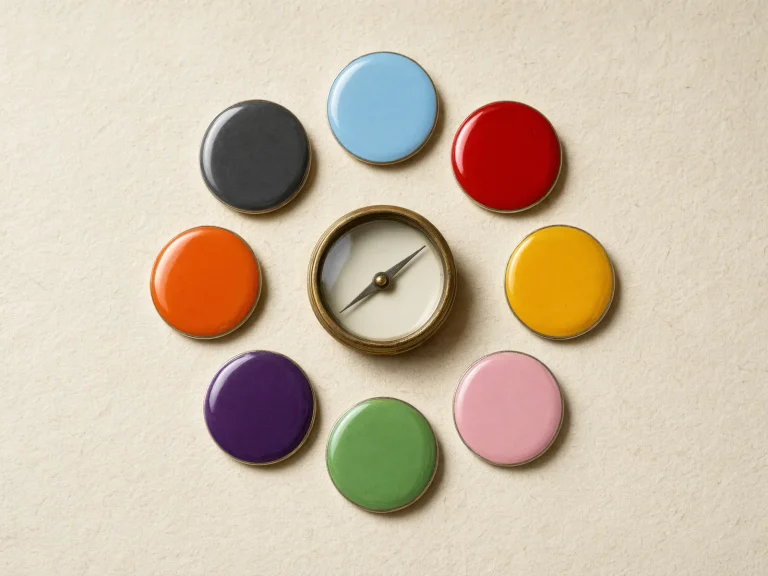
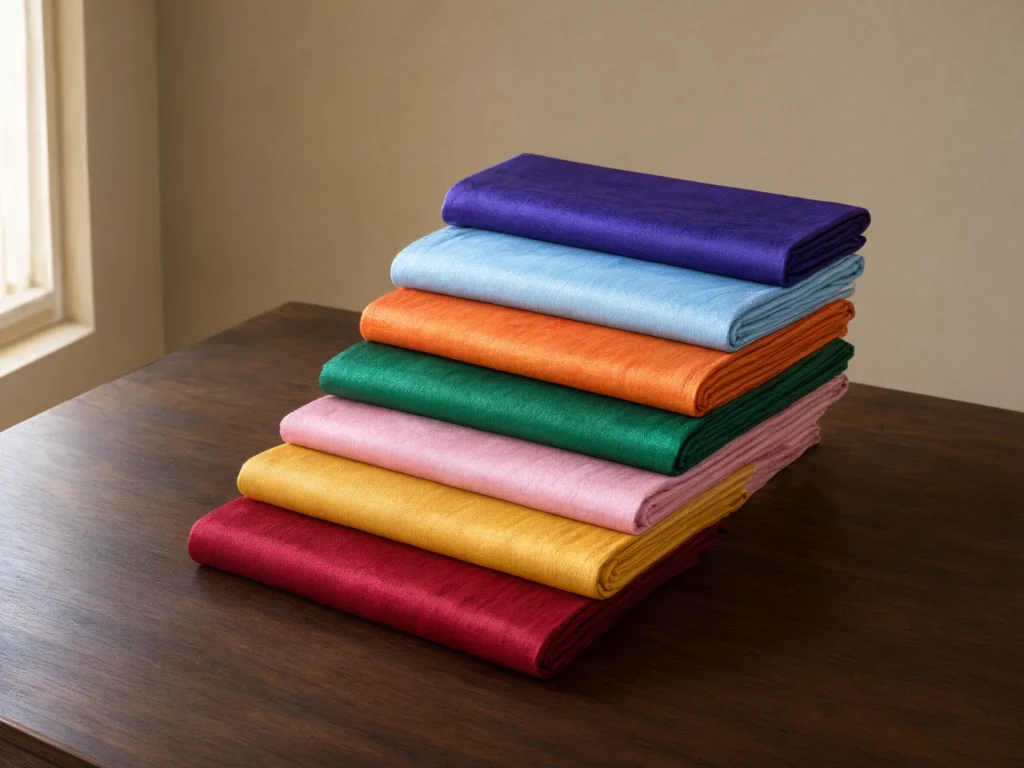
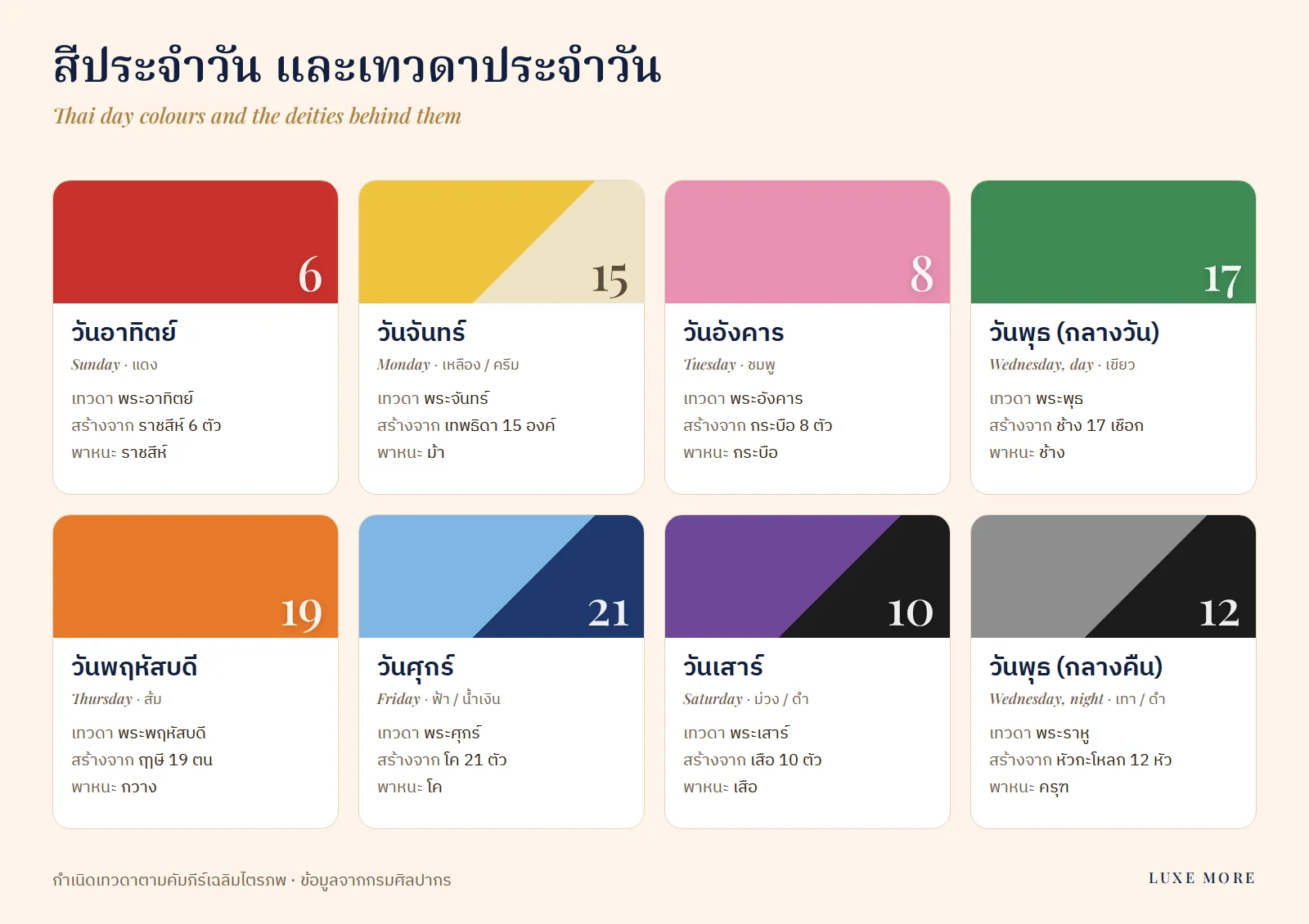
- Today’s day colours: red for Sunday, yellow for Monday, pink for Tuesday, green for Wednesday, orange for Thursday, light blue for Friday and purple for Saturday. People born on Wednesday night take Rahu’s colour, black or grey.
- The colours go back to the day deities of the Chaloem Traiphop, but today’s set settled only in later times, and some older texts give different colours.
- The day power numbers 6, 15, 8, 17, 19, 21, 10 and 12 are how many beings went into making each deity in the legend. Together they add up to exactly 108.
- In Thai astrology the day changes at 6 a.m., so anyone born before then counts as born on the previous day.
Ask a Thai person which day they were born on and most will answer straight away; many know their day colour too. These colours sit quietly in everyday life, from what we wear on important days to the small things we carry. Trace them back, though, and there is more to the story than most people expect, and some of what gets passed around does not quite match the evidence.
The day deities: a legend from the Chaloem Traiphop
Day colours are tied to the nine planetary deities, the nopphakhro. According to the Chaloem Traiphop, the god Shiva made each deity from a set number of animals or beings, ground them fine and wrapped them in cloth of a particular colour. Each deity that emerged had its own body colour, mount and direction. The same story also exists as a chanted verse, Chaloem Traiphop, attributed to Phraya Ratchaphakdi (Chang) in the reign of King Rama V.
| Day | Made from | Body colour | Mount |
|---|---|---|---|
| Sunday · the Sun | 6 lions | Red | Lion |
| Monday · the Moon | 15 goddesses | Creamy white | Horse |
| Tuesday · Mars | 8 buffaloes | Copper, wrapped in dusky pink cloth | Buffalo |
| Wednesday · Mercury | 17 elephants | Green | Elephant |
| Thursday · Jupiter | 19 hermits | Red-orange | Deer |
| Friday · Venus | 21 cows | Light blue | Cow |
| Saturday · Saturn | 10 tigers | Dusky black | Tiger |
| Wednesday night · Rahu | 12 skulls | Jet black with a copper sheen | Garuda |
The ninth deity, Ketu, was made from nine naga serpents but has no day of its own, so it has no birthday colour. The texts also differ in the details: the chanted verse makes Jupiter yellow, and some versions mount Jupiter on an antelope or Rahu on a giant. The table above follows the Fine Arts Department.
The day power numbers come from the legend
The numbers in the legend are not there just for the story. Six lions, fifteen goddesses, eight buffaloes, seventeen elephants, nineteen hermits, twenty-one cows, ten tigers and twelve skulls are the planets’ strengths, popularly called the day power numbers. In the Maha Taksa system the same numbers are also the years each planet rules over a person’s life.
Add up all eight and you get exactly 108. Ketu rules no years of life, so it is left out.
The numbers are still used today. The Astrologers Association of Thailand suggests chanting your birth-day prayer as many times as your day’s number: 6 for Sunday, 15 for Monday, 8 for Tuesday, 17 for Wednesday day, 12 for Wednesday night, 19 for Thursday, 21 for Friday and 10 for Saturday.
So why is Monday yellow?
Put the modern colours next to the deities’ body colours and some match while others don’t. Sunday red, Wednesday green, Thursday orange and Friday light blue all match. Tuesday’s pink matches the wrapping cloth. But Monday, creamy white in the legend, became yellow, and Saturday’s dusky black became purple.
Older records show the colours moving around. In Nithra Chakrit (1879), Tuesday is already pink and Saturday pale purple, but Monday is white, Thursday yellow and Friday dark blue. The Wild Tiger Corps officers’ flags of King Rama VI’s reign have Monday yellow, but Friday white and Saturday black. When and why today’s set settled has not been clearly documented.
The honest summary: day colours really are rooted in the planetary deities, but they were never a straight copy, and they have changed more than once. When two texts disagree, it doesn’t necessarily mean either is wrong.
What Sunthorn Phu’s Sawatdi Raksa really says
Sunthorn Phu’s poem Sawatdi Raksa is often quoted as the source of daily clothing colours. He wrote it for Prince Aphon around 1822–1824, as Prince Damrong explained. The passage on colours, though, is about dressing for battle: the colour depends on the day you go to fight, not the day you were born.
Its colours don’t match today’s set either: red for Sunday, creamy white for Monday, purple mixed with indigo for Tuesday, vermilion for Wednesday, yellow-green for Thursday, the grey of cloud and mist for Friday, and black for Saturday.
Royal birth-day colours
Wearing the royal birth-day colour has been a court custom since King Rama V’s reign. The image most Thais remember is yellow on Mondays. King Rama IX was born on Monday 5 December 1927, and in 2006, the 60th year of his reign, government agencies invited civil servants to wear yellow every Monday. King Rama X was also born on a Monday, and in 2024 the government again asked state agencies to wear yellow on Mondays to mark his sixth-cycle, 72nd birthday.
The light blue of Mother’s Day comes from the same idea: Queen Sirikit, the Queen Mother, was born on Friday 12 August 1932.
Born at 3 a.m.? Which day counts
Thai astrology doesn’t change the day at midnight the way a calendar does. It changes at sunrise, which most texts fix at 6 a.m. If you were born after midnight but before 6 a.m., you count as born on the previous day.
- Born on a Tuesday at 3 a.m.: you count as a Monday birth.
- Born on a Wednesday between 6 a.m. and 5:59 p.m.: Wednesday day, Mercury, green.
- Born on a Wednesday from 6 p.m. until just before 6 a.m. on Thursday: Wednesday night, Rahu.
- Born on a Thursday at 4:30 a.m.: that is also Wednesday night.
Some calculations use the actual sunrise for the date and place of birth instead of a fixed 6 a.m., and the verse Chaloem Traiphop starts Rahu’s hours at dusk. If you were born close to 6 a.m. or 6 p.m., ask the astrologer you trust which rule they follow.
Enjoying your day colour
Day colours are a tradition that adds colour to life, not a list of rules to obey. Many people keep theirs in small things they carry every day, like a phone case, a wallet or a charm on a watch band, so the colour is with them every day without changing a whole outfit.
To see which colours support what, and which to avoid, read our piece on Taksa next, or enter your birth date and time in the Lucky Charm Finder. It counts days the same way as this article: the day changes at 6 a.m., and Wednesday day and night are told apart for you.
Common questions
What time does Wednesday night start?
By the usual rule, anyone born on a Wednesday from 6 p.m. until just before 6 a.m. on Thursday is a Wednesday-night birth, ruled by Rahu, with black or grey as the colour.
Why do some sites say Monday is white or cream?
Because in the legend the Moon’s body is creamy white, so texts that follow body colours use white or cream. Yellow is the colour most widely used today. Both have a source.
Are birthday colours the same as the colours in Sawatdi Raksa?
No. Sunthorn Phu’s Sawatdi Raksa gives colours to wear by the day you go into battle, and several of them differ from today’s day colours.
Sources
- Fine Arts Department: the planetary deities, their colours, mounts and strengths (Thai)
- Chaloem Traiphop, chanted verse, Vajirayana Digital Library (Thai)
- Sawatdi Raksa by Sunthorn Phu, Vajirayana Digital Library (Thai)
- Amnat Paksasuk (2013), “Taksa and Thai naming”, Vannavidas, vol. 13 (Thai)
- Sarakadee magazine: the origin of the days and their deities (Thai)
- Sarakadee magazine: flag colours and day colours under King Rama VI (Thai)
- Silpa Wattanatham: royal birth-day colours (Thai)
- Matichon: chanting by your day number (Thai)